Tuesday, May 31, 2016

What You Need to Know: Small Business Trends 2016

A quarter into the year 2016 offers no contention as to what's hot and what's not in the world of business. With technology upgrading year after year and the rise of smart phones and mobile marketing, there is so much small businesses can do to become the best. Here are some of the top trends:

Connecting with customers
With the advent of the Internet and increased access, connecting with customers has been made easier. Ecommerce, websites, and social media have become one of the most widely used marketing tools. It's easy, fast, and the best portal for a world seeking instant gratification. According to a Forbes article, we live in a Connection Economy, where the most successful companies are those who connect people and build relationships. Facebook, for example, is the largest media company but they don't create content, relying more on the interaction of its members to gain traction and income.

Embracing Millennials
Millennials now represent the largest employee and customer segment of the population and despite their different views about how businesses should be run or how the office should look like, it's a good idea to embrace them and their ideals. Millennials are the future of business as many of them would rather be their own boss than to work for someone else. They can easily adapt to ever-changing technologies and can offer creative insights on how to improve businesses.

Business Intelligence
Since almost everything is done online, people have developed ways to convert all those data into information that entrepreneurs can use to develop and improve their business. Knowing how to use statistics and business intelligence helps you figure out what works and what doesn't to help your business grow.

Hey there, I'm Janique Goff, business advisor and firm believer of eco-friendly business. Subscribe to my blog to learn more about how to go green.

Monday, April 25, 2016

A little green goes a long way: Going green at the office

With global warming threatening on our planet, it is our job as Earthlings to start changing our ways.  It doesn’t matter how big or how small the action is, because little things make a whole lot of difference.  Here are some ways to transform your workplace into an eco-friendly environment:

Go digital

Do you really need five copies of the meeting agenda? Or do you need to reprint a document on a new piece of paper for every minute revision?  Since we’re living in the digital age, it’s time we make full use of electronic devices to go paperless.  Invest in online cloud storage to keep important documents or share them with your colleagues.  Discard printouts and simply send out presentations through email.  If you must print, you could buy post-consumer waste (PCW) paper, which is actually made from recycled paper.


Power down

As much as possible, try not to leave any electrical equipment such as computers, printers and scanners plugged after office hours.  Even if they are set on standby, they may still be using up electricity.  Turn off all computers when not in use and toggle the computer settings to powersaving mode.  This will significantly lower the electricity bill, which is good for conserving energy and company resources.

http://i.huffpost.com/gen/2530506/images/o-DIGITAL-AGE-facebook.jpg
Image source: huffpost.com
Green transportation

Encourage your colleagues to consider more eco-friendly ways to travel to the office.  One way is to bike to work or carpool or best yet, walk (assuming it’s manageable).  These ways are not only good for the environmeny but for your physical health as well.


Redesign the office

If it’s within the budget, you can opt to redesign your office using refurbished office furniture or converting all lights to compact-fluorescents (CFL) or LEDs. This may be quite expensive but it will have significantly huge impact on company savings.

http://greenliving4live.com/wp-content/uploads/2013/09/bringing-a-picnic-green-inside.jpg
Image source: greenliving4live.com
Hello there! I’m Janique Goff and I’m a firm supporter of going green in business. Visit my blog for more notes on eco-friendly business endeavors and other related topics.

Tuesday, August 25, 2015

Mother Nature vs. Tech: How Technology is Affecting the Environment

There is no denying the many positive effects of technology in today's society, and its necessity in people's daily lives has become widespread. As a result, the amount of energy being used increases as technology advances further. This phenomenon raises the question: Do the negative effects of progress outweigh its benefits?

https://dannyking23.files.wordpress.com/2014/03/nature-and-technology1.jpg
Image source: dannyking23.wordpress.com
Benefits of technology

Society today thrives in technology, and it is used in all aspects of daily living. From transportation to business to education, technology has indeed permeated the entire world.

Technology has made everything easier, faster, and more efficient and productive with less effort. Among the most useful devices and gadgets are cars, smartphones and computers, all of which many cannot live without. Even in the household, technology has become essential. Television sets and high-tech appliances (i.e. dishwashers, washing machines, and dryers) have become standard fixtures in most homes.

The downside technology

As much as technology has made human life more convenient, so is its effect on the environment troubling. The mass use of electronics has continually increased energy consumption. The process of energy production is one of the main reasons for air pollution, which will continue to destroy the earth's atmosphere if not remedied. Among other contributors to pollution are greenhouse gases from household products and appliances as well as the smoke and fuel combustion from cars.

http://www.hdrinc.com/sites/all/files/imagecache/medium/content/pages/page-images/5063-hdrs-carbon-footprint.jpg
Image source: hdrinc.com
A lot of human actions contribute to the destruction of Mother Nature but it is not too late to stop it. Find our more ways to help the environment by following Janique Goff on Facebook.

Monday, July 20, 2015

Renewably Good: The Benefits of Biofuels

With the lessening supply and increasing price of oil and gas, alternative sources of energy find their way into the global market. Among these alternative energy sources is the biofuel.

Biofuels are fuels extracted from plants and crops, most commonly from corn and sugar. However, biofuel source is not limited to these as sometimes it is extracted from animal fats or recycled greases. Bioethanol, or simply ethanol, and biodiesel are the most common of these biofuels.

By simply looking at its definition, you would know why biofuel starts to become an important alternative source of energy today.

The price of crude oil soars every day, considering that this type of energy source is limited. Although the supply of crude oil is still far from reaching its end, it does not remove the fact that it will come to an end. For this reason, biofuels are making a name in the energy industry. Biofuels are renewable and sustainable since it is extracted from plants and crops, which can be readily produced when needed. Unlike fossil fuels, plants and crops can be replanted again and again.

Image sourcehowstuffworks.com
Another benefit the planet receives when people use biofuels is its potential to reduce greenhouse gases. On the one hand, fossil fuels, when burnt, releases huge amounts of greenhouse gases that trap sunlight and cause global warming. On the other hand, studies show that biofuels reduce greenhouse gases up to 65 percent. Although the production of biofuels creates carbon dioxide as a byproduct, this same carbon dioxide will serve as food for the same plants where biofuel is extracted. This makes it something close to a self-sustaining system.

Janique Goff supports eco-friendly business startups including those that develop renewable energy sources such as biofuels. Learn more about renewable energy sources here.

Tuesday, May 5, 2015

REPOST: Why Tesla is backing batteries

Electric car manufacturer Tesla is branching out to batteries with efficient energy storage, which have profound implications beyond just powering its cars. According to the BBC, it's all in the name of good business.

Image Source: bbc.com
Powerwall uses the same basic batteries found in many electronic gadgets

Car maker Tesla has unveiled plans to start making large batteries that can be used to store power in homes and businesses.

It has unveiled two versions of the wall-mounted battery packs and said it hoped to start shipping and installing the devices by the summer.

BBC News looks into the announcement and its implications.

Why is a car maker helping power homes?

The same technology used to power Tesla cars, a lithium ion battery, will also be used in the large battery packs it is about to start making.

It is likely that many of the first people to buy a battery pack will be people who already own a Tesla car and are looking for a cheaper way to charge their vehicle.

In many places, charging the car's battery using solar power will be much cheaper than doing it using electricity from the grid.

Aside from this, the battery packs could prove useful to people keen to cut their electricity bill by generating some of the power they use from the sun. Others may use them to store energy bought when it is cheap so they can avoid paying for higher-priced power.

Tesla also has plans to sell the batteries to utility companies as a way for them to store the power they generate at times of low demand.

Are the home batteries the same as those in Tesla cars?

Not exactly. Those in the cars are optimised to charge more quickly than the domestic versions.

Lithium-ion technology is very well established and is used in the majority of gadgets that have rechargeable batteries. Other electric cars use them to store power too.

Before now one of the bottlenecks holding back wider adoption of lithium-ion batteries has been a lack of factories making them. Tesla hopes to address this with the building of what it calls a gigafactory which, when completed in 2020, will be the world's biggest.

The building of the factory, says Tesla, should help drive down the cost of the technology.

Are there other obstacles to large-scale adoption?

Image Source: bbc.com
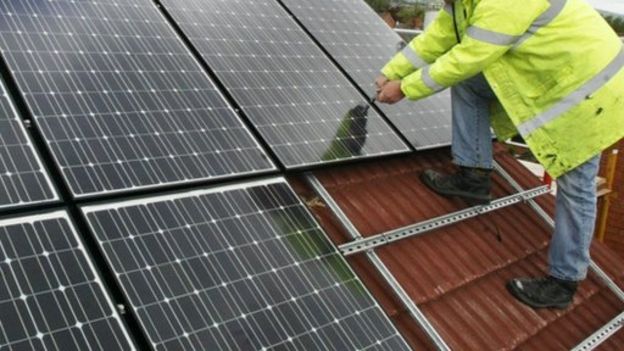
The cost of installing solar panels and the Tesla battery may be too high for many people

Yes. Cost. The price quoted by Tesla does not include installation of the unit. To this needs to be added the cost of installing solar panels to gather energy.

It might take years for the combination of solar panels and battery to pay for itself.

Tesla claims that its batteries could be useful during disasters when power is knocked out for days. However, well-established generator technologies that are powered by petrol or diesel will probably remain cheaper than lithium-ion batteries for some time.

Despite this, Tesla is working to remove one big obstacle which is getting commercial partners aligned to be able to deliver and install the technology in homes.

Is Tesla the only company doing home power storage?

No. Many other companies and nations are keen to find ways to power energy generated from renewable sources. Sometimes this is because the supply of the power from wind, water and the sun can fluctuate - a reliable store will help smooth out the peaks and troughs.

In addition, some sources of renewable energy, such as solar power, are absent when people need power the most - at night. Again, storing power would help solve this problem.

Home storage of power is also getting more interest because in many nations, established electricity generators are slashing the rates they pay customers who provide them with power from the solar panels mounted on the roof of their home.

In the UK, there are several small-scale trials involving a few hundred homes that are based around systems that store power generated from the sun.

Could the battery systems be used in developing nations?

Image Source: bbc.com
Many regions lack the power infrastructure to keep homes lit at night

Tesla thinks so. However, there can be many reasons why people in such places do not have power. It is not clear that a relatively expensive system such as Tesla's will work well in such locations.

In addition, there are many NGOs and green innovation firms looking at bringing much cheaper, and more robust, power generation systems to developing nations.

What is clear is that although many of these places have an abundant supply of solar power they lack the infrastructure and local expertise that are likely to make the Tesla initiative a success in the US.

Having backed several biotech startups, Janique Goff is an ardent supporter of the development of green technology. Follow her on Facebook for more updates on eco-friendly tech developments.

Monday, April 13, 2015

REPOST: The Future of the Electric Car

The production of electric cars has brought an enormous change in the advocacy for a cleaner environment. This article from Greentech Media provides us a glimpse of where the electric car stands in the current and future market.

There are now over two dozen all-electric and plug-in hybrid electric vehicles on the market and at least two dozen additional models that are slated to be available in the next couple of years. Mercedes alone just announced that it will be offering 10 different plug-in hybrid models in the next couple of years, following a similar announcement by BMW in March.

The world’s best-selling EV is still the Nissan Leaf, a modest little passenger vehicle, with over 165,000 units sold by March of this year since its release in late 2010. A new study found that the batteries have been very reliable, with 99.99 percent of the 35,000 Leafs sold in Europe still working perfectly.

The Mitsubishi Outlander PHEV and the Tesla Model S are the second and third best-selling EVs today, respectively, even though the Outlander hasn’t yet been made available in the U.S.

Total global sales of EVs/PHEVs amounted to 320,000 units in 2014, an 80 percent rate of growth and on pace to easily exceed 500,000 in 2015. Cumulative sales reached 740,000 vehicles by the end of 2014 and will top 1 million by the middle of 2015. That is still less than 1 percent of the global auto market, but it shows that EVs and PHEVs are here to stay. Global vehicle sales are projected to reach approximately 89 million units in 2015. If global EV sales reach 500,000, this will equate to about 0.6 percent, putting us on track to reach 1 percent of global sales in 2016.

As I described in a previous column, 1 percent is halfway to market dominance in terms of the doublings required to get from nothing to 1 percent and then from 1 percent to 100 percent. It takes seven doublings to get from 1 percent to over 100 percent and the same to go from nothing to 1 percent.

Figure 1: Global EV Sales Through 2014

Image Source: greentechmedia.com

In this column, however, I’m not going to talk about the magnitude of sales in the future. Rather, the future I’m focused on here is the future of EV technology itself. How will EVs evolve in the next decade, the years that are already a little bit visible on the horizon? I’ll focus on three main trends: 1) improving battery technology; 2) lightweighting of vehicles; and 3) automation. Sorry, no (mass-market) flying cars are around the corner -- yet.

Improving battery technology

We can learn a lot by looking at learning curve models for batteries. Today’s prevailing battery technology for EVs is lithium-ion. It’s good, but far from perfect. Even though today’s lithium-ion batteries hold two and a half times the energy they did in 1991 and cost 10 times less, lithium-ion technology is still too energy-diffuse and expensive compared to where it needs to be to become truly mainstream. But we’re well on the way. Figure 2 shows the various battery technologies and fuel cells in terms of their energy density.

Figure 2: Energy Density of Battery and Fuel-Cell Technologies

Image Source: greentechmedia.com

The current holy grail for EV batteries is getting costs down to $100 per kilowatt-hour, down from $250 to $300 per kilowatt-hour today. The expectation is that at this cost, EVs can compete with internal combustion vehicles without subsidies. The exciting development in the last year is that not only is Tesla’s Musk saying that the firm hopes to reach this level in the next decade with production from its Giga factory, but that others are agreeing with him, including the Motley Fool, the independent financial research entity.

Lithium-ion batteries will probably start showing marginal improvements around that time, however, in terms of continuing cost declines and increasing energy density. Most experts today think that lithium-ion batteries will top out at around 400 watt-hours/gram or even less, up from around 250 today. Around that point, it’s likely that we’ll see markets shift toward different technologies in order to continue the trend toward increased energy density.

One new technology that shows promise is lithium-air (also known as lithium-oxygen), which uses ambient air to aid energy flows and results in less degradation than seen in other types of batteries. The long-term holy grail of lithium-air batteries is achieving an energy density on par with gasoline, which is theoretically achievable with this technology, and would allow batteries to take up much less space than they do today. The technology would offer about 10 times the energy density of today’s batteries.

However, the future is not at all clear for lithium-air batteries, and some researchers think they’re a lost cause. Others aren’t ready to bow out yet, including Peter Bruce of the U.K.'s University of St. Andrews: “We are closer to what’s needed than we were a few years ago.

As with Moore’s law and the speed and cost of computing power, we can expect to continue to see major improvements in battery technology in the coming decade. With Tesla and Panasonic throwing literally billions of dollars behind improved lithium-ion batteries, it’s likely that lithium-ion will remain the go-to battery technology for EVs in the next decade. It’s also possible, however, that other types will make major breakthroughs in that same time period and reach the broader market.

My best bet is that we’ll continue to see incremental improvements in lithium-ion energy density, but also continue to see steady decreases in costs. This is the case because costs will decline based on increases in the scale of production and learning curve effects relating to this scale and associated manufacturing techniques, independent of any major improvements in the actual architecture of the batteries. Such improvements will be icing on the cake, but probably not necessary to achieve major improvements over today’s density and costs

Lightweighting

Interestingly, we can achieve exactly the same improvement in EV range or reduction in costs by making cars lighter as we can by making more energy-dense batteries. And it may actually be easier to do it by making cars lighter, because there is less of a diminishing return phenomenon in taking today’s relatively heavy cars and making them lighter with the use of new materials and techniques.

We’re already seeing many technologies leading to lighter and more efficient cars, regardless of whether the cars are electric or gasoline or diesel. Some kind of fuel economy standard is in place now for 80 percent of the world’s passenger vehicle market, according to the International Council on Clean Transportation. Figure 3 shows the vehicle fuel-efficiency standards for the world’s largest economies at the end of 2014. The general trend that's predicted is a 50 percent reduction in the emissions from passenger vehicles between 2000 and 2025. We’re about halfway to achieving that goal, and it is realistic to expect that the 2020-2025 goals will be met due to the many new technologies arriving that will improve fuel efficiency and decrease GHG emissions.

Figure 3: Vehicle Fuel Efficiency Standards for Various Countries
 
Image Source: greentechmedia.com

As a consequence of these trends (and many others), IEA projects, in its 2015 World Energy Outlook, that oil demand will rise to 104 million barrels per day by 2040, up from 91 mbpd in 2014. This is a significant increase, but it’s a large decline from previous forecasts that reflects the increasing role of improved vehicle fuel efficiency around the world. We can anticipate additional vehicle fuel efficiency to materialize in the coming decades, going far beyond the 52.5 miles per gallon requirement under the U.S. CAFÉ standard for 2025.

Many EVs are already quite small. The smallest commercially available model is the Renault Twizy, with over 15,000 already on the road in Europe (it’s not available in the U.S.). The Fiat 500e is tiny (I should know since I drive one), and the Smart ForTwo EV is even smaller. Are we destined for a future filled with electric go-karts? Well, we’ll surely have many more of these truly tiny vehicles on the road, particularly in dense urban areas, but we’re also going to see plenty of normal-size cars becoming increasingly lightweight.

Amory Lovins and the Rocky Mountain Institute have for many years pioneered the “Hypercar” idea that includes a radical redesign when it comes to weight. Lovins describes many aspects of this vehicular evolutionary process in his 2011 book, Reinventing Fire. He states: “Investing R&D effort in vehicle fitness (which got about a hundredfold less in U.S. research budgets through 2010) will yield the same result [as better batteries] with less cost, time, and risk.”

Ford made big news recently by announcing its use of aluminum for much of the frame in its top-selling F-150 line of trucks. The 2015 model is 700 pounds and about 15 percent lighter due to this shift from using steel in favor of using aluminum. Ford is claiming up to a 20 percent improvement in fuel efficiency, due largely to this change in weight. The aluminum used in these trucks is about twice as strong as steel and thus safer in accidents, as well as lighter.

Steel is not giving up without a fight, however, and some companies are planning to use high-strength steel to reduce the weight of cars rather than alternatives like aluminum. ArcelorMittal, a steel manufacturer, released a survey suggesting that pickup trucks could achieve an average 23 percent improvement in weight by using the new high-strength steel products combined with expected improvements in powertrains.

One idea that Lovins has highlighted for years is also starting to come to fruition: carbon fiber vehicle bodies. The BMW i3 compact hatchback is far lighter than comparable cars because, in part, its body is made mostly of carbon composites, the same stuff that modern airplanes are increasingly being made from. This is the first car (let alone EV) to use primarily carbon fiber for its body. Carbon fiber is 30 percent lighter than aluminum and actually stronger. The i3 weighs 2,635 pounds, significantly less than the average weight of 3,000-4,500 pounds for the typical compact car. The Chevy Volt, for example, another highly fuel-efficient car and also officially a compact car, weighs 3,786 pounds. Even the tiny Fiat 500e weighs more than the i3, at 2,980 pounds.

The i3 represents a big shift in long-term trends in car weight, because after a massive drop in the 1970s, in response to the oil crises, most vehicles steadily gained weight from the 1980s through to the present. We can expect, with the federal CAFÉ standards for 2025 being quite aggressive, that other automakers will follow BMW’s lead in terms of using new materials in a long-term quest to create much lighter cars.

Over 20,000 i3s have been sold worldwide since its late 2013 release, and by all accounts, it’s a great car with no issues relating to its carbon frame. U.S. sales of over 1,000 vehicles in February 2015 put the i3 at third place after the Nissan Leaf and Tesla Model S and well above the Chevy Volt and Prius Plug-in hybrid.

Automation

We’re also going to see cars become far more automated. It seems that the hurdles to driverless cars are now largely legal rather than technical, and my feeling is that we’ll have fully autonomous cars in the next few years -- and maybe even sooner for some models.

Tesla has earned a lot of attention when it comes to driverless cars, and it may well lead the pack to achieving a fully autonomous vehicle. Musk has announced a suite of “autopilot” capabilities that are coming via software update this summer to the company’s signature Model S. Musk stated that the new features could in theory allow the car to drive itself from parking lot to parking lot on long drives throughout much of the U.S., but for now, it will be limited to highway driving due to the legal obstacles currently in place.

Many other brands are also working on fully autonomous cars, and most luxury cars have an increasingly sophisticated suite of automated driving abilities. The Audi A7 completed a test drive with its autopilot from the Stanford campus in Palo Alto to Las Vegas, Nev. earlier this year without incident. Mercedes and Cadillac models also have many autopilot features already included, with surely many more features to come.

In sum, it seems pretty likely that we’ll have fully autonomous cars by 2020 or even sooner. That’s pretty cool, and I personally look forward to telling my car to take me to Yosemite for the weekend as I kick back for a nap.

A future column will look at even more exotic aspects of the future evolution of the cars we drive -- and that increasingly will be driving us.

An advocate of a greener and cleaner planet, Janique Goff has been involved in the development of businesses focused on green technology. For more related articles, follow her on Twitter.

Saturday, March 7, 2015

REPOST: Nature camp offers outdoors adventure for kids

Summer camps teach children a lot about the environment, the crucial role it plays in sustaining life on Earth, and how little things can make a strong impact on the preservation of Mother Nature. Get more insights from the article below:


Campers are shown on one of the many field trips provided by Hudson Highlands Nature Summer Science and Nature Camp | Image source: poughkeepsiejournal.com


Although winter is still weighing heavily in the Hudson Valley, spring will be here before you know it, and it’s not too soon to start planning for summer camp for children and teenagers.

The Hudson Highlands Nature Museum is getting ready for summer campers. The Museum’s Science & Nature Camp, for children ages 4-12, takes place in one-week sessions from June 29 until Aug. 28. There is also a two-week program for ages 13-16. The camp features a bucolic setting, small group size and experienced Hudson Highlands Nature Museum staff.

“We are very excited about this year’s summer camp,” education director Lisa Mechaley said in a written statement. “Our experienced staff members bring great strengths to this program and they enjoy sharing science, nature and the outdoors with children.”

Space is limited and early registration is encouraged. Online registration is available. Early drop-off and late pick-up are also offered. There is a 3 percent discount for those who register before April 3.

Here’s a look at this summer’s programming:

•The Ramblers Program is for children ages 4-6. This program meets in week-long sessions at the museum’s Outdoor Discovery Center. Half-day sessions are offered for children ages 4 and 5 from 9-11:45 a.m. and a full-day program is offered for ages 5 and 6 from 8:45 a.m. to 2:45 p.m. Extended hours and a lunch program for the half-day ramblers are an option. Campers will take part in nature adventures, hikes, crafts, games and music. Every week will include a field trip day to the museum’s Wildlife Education Center to meet live animals and experience its exhibits and trails. Parents provide transportation.

•The Trekkers Program is for children ages 7-12. Campers take part in week-long, adventure programs. This camp takes place at the museum’s Outdoor Discovery Center. One day each week is spent exploring the Hudson River at Kowawese Unique Area in New Windsor and another day on a field trip or hike. Campers meet for a six-hour day (9 a.m. to 3 p.m.) each week and bring their own lunch, bottled water and snack. Extended hours are an option. Transportation is by chartered bus for field trips. Parents provide transportation to local off-site destinations.

•The Eco-Rangers Program is for children ages 13-16 and features two weeks: July 20-24 and Aug. 10-14. Eco-Rangers will start the week with three days of wilderness adventures, including two day-long expeditions kayaking or canoeing, and hiking or participating in a high ropes course. They will complete the week with one overnight stay, sleeping under the stars with a hammock to keep. Dinner, s’mores, ice cream and breakfast are included. This camp takes place at the museum’s Outdoor Discovery Center, 9 a.m. to 3 p.m., Monday-Wednesday; 6 p.m. Thursday to 8 a.m. Friday.

Interested campers can find out more information, become a member or register for camp at hhnm.org and click on “summer camp” or call 845-534-5506, ext. 211.


For more links, news, and insights on environmental protection, follow Janique Goff on Facebook.