Monday, January 28, 2013

Beeware of food supply drop: How bee population decline impacts agricultural yield

Climate change has taken its toll for more than a century now. The past decades may have seen its effects less violently, but the recent natural tragedies suggest that its impact is escalating big time. In fact, it is harming even the tiniest members of the biosphere, fuelling a chain reaction that affects many other forms of human activities particularly agriculture.

Image source: commons.wikimedia.org
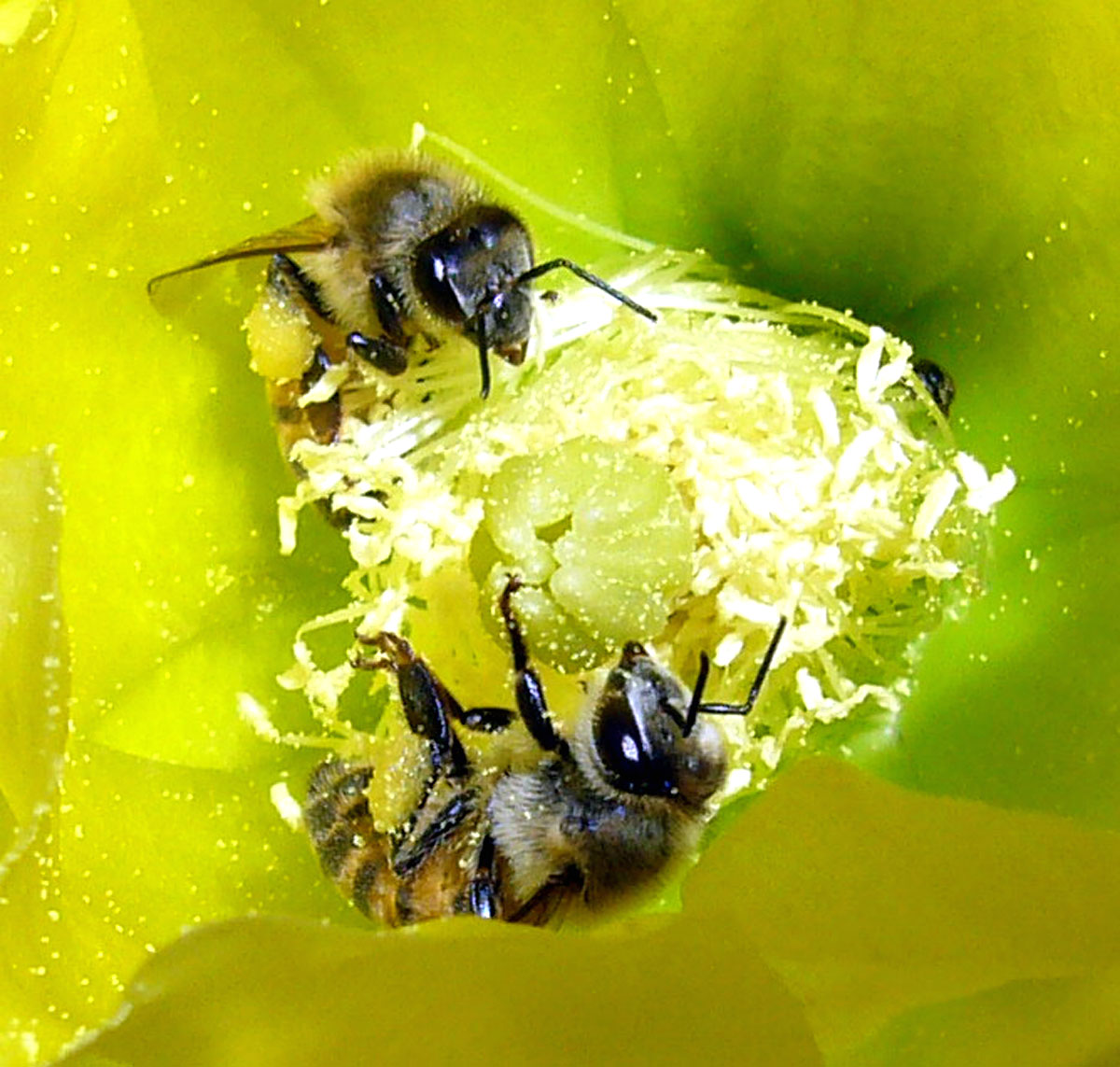
Bees, via pollination, contribute to a sizable crop yield in America. However, their present population has rapidly dwindled as compared to their number more than 50 years ago. The culprit is believed to be climate change and its associated factors, such as diseases spread by parasites and the spraying of crops with pesticides. This ecological catastrophe is plaguing the agriculture sector on a large scale.

Image source: commons.wikimedia.org

Unless immediate actions are taken, food supply in the US can be put in peril. The farmers’ inability to meet production quota can become a permanent dilemma and consequently, shelves in food stalls and grocery stores might become nearly empty. For example, in February 2004, there were inadequate honeybees for all the almond blossoms in California, resulting in farmers failing to meet expected yields.

“There are shortages that pop up from time to time,” says Claire Kremen, a conservation biologist at Princeton University. “Whether there are more [shortages] than there were 20 years ago, one would guess yes, as there are fewer bees to go around, but it's not well documented.”

Image source: commons.wikimedia.org

While honeybees are not yet totally extinct, it is better that everyone helps in fighting the many ill industrial activities of man that possibly cause the insects’ population decline. People should also help expand green horizons through reforestation and increase the production and use of renewable energy. Small contributions can make a huge difference.

Janique Goff is an active supporter of programs and causes that gear toward eco-preservation and sustainable development. This blog provides more information about her advocacy for nature.

Wednesday, December 26, 2012

A greener future from the concrete jungle

When asked what an environmentally friendly human settlement would be like, the last image that anybody thinks would be a large city. Combining the swelter of the urban heat islands with the pollution emitted by vehicles and factories, the city is as far from the typical person’s vision of the environment.

Janique Goff - greener future
Image credit: packworld.com

However, many ecologists believe that densely populated cities are, when planned properly, far more beneficial to the environment than they let on. This is because a densely populated city is more contusive to the use and development of public transportation such as buses, trains, and rapid transit systems, which, when combined with transit-oriented development, can cut down on commute times. Moreover, city dwellers tend to live in smaller homes, which need less energy to cool and heat.

This also reduces carbon dioxide emissions and cuts back on air pollution, assuming that its growth could be controlled. Large cities in places like Europe and North America tend to have smaller carbon footprints.

Janique Goff- urbanization
Image credit: georgetownclimate.org

The main hindrance to the benefits of urbanization is uncontrolled and poorly planned growth, which usually takes place in developing economies like those in Asia. In some places, the growth of the urban population far outpaces the capacity of the municipal governments to provide basic utilities, let alone proper planning.
For urbanization to be ultimately beneficial, it must be intelligently managed. Doing so would reduce its environmental impact while providing for the needs of its residents in an efficient, effective manner.

Janique Goff- proper urban management
Image credit: citiesrt.org

More on the environment and green technology can be accessed on this Janique Goff blog.

Thursday, November 22, 2012

Second Life for Old Electric-Car Batteries: Guardians of the Electric Grid

By Josie Garthwaithe, National Geographic. Original article and images can be accessed here.

Imagine a future in which old electric-car batteries are deployed in neighborhoods as energy-storage systems that guard against power outages, while paving the way for wind and solar power—and more electric cars. The idea has moved one step closer with the demonstration of a boxy unit of used Chevy Volt batteries capable of providing enough electricity to power three to five average American homes for up to two hours.

Developed by General Motors and ABB, one of the world's largest electric-technology companies, the device features five lithium-ion battery packs from plug-in hybrid Volts, strung together in a new arrangement and cooled by air instead of the liquid used in their former lives on the road. The batteries are degraded below acceptable performance levels for cars, but the companies say the batteries have enough life to serve the grid for at least ten years in this device, a community energy storage unit.

"In a car, you want immediate power, and you want a lot of it," said Alexandra Goodson, business development manager for energy storage modules at ABB. Many grid storage applications, on the other hand, involve slow, steady delivery of energy. "We're discharging for two hours instead of immediately accelerating," she said. "It's not nearly as demanding on the system."

The Road to Renewables

The partners previously demonstrated the technology in a lab environment. Now, said Pablo Valencia, senior manager of battery lifecycle management at GM, "It's become a reality," during a presentation Wednesday in Sausalito, California, where GM set up a demo unit about the size of a few refrigerators to power video, lights, and audio in an outdoor tent. "This is an industry first, to be able to use secondary automotive batteries in a grid-based application," Valencia said.

To test the repackaged Volt batteries in the real world, partner Duke Energy, the largest utility in the United States, plans to install this unit next year in the field alongside a transformer. "We'll test it as long as it takes to highlight all the value streams," said Dan Sowder, senior project manager for new technology at Duke.

Deployed on the grid, community energy storage devices could help utilities integrate highly variable, and sometimes unpredictable, renewables like solar and wind into the power supply, while absorbing spikes in demand from electric-car charging.

"Wind, it's a nightmare for grid operators to manage," said Britta Gross, director of global energy systems and infrastructure commercialization for GM. "It's up, down, it doesn't blow for three days. It's very labor-intensive to manage." Sowder, whose company serves 7.1 million customers in the U.S. Midwest and Southeast, explained, "Our grid, and most electricity grids, are not really designed to handle that kind of rapid swinging. Storage can help dampen that out." Smooth delivery of renewable energy has been a major research area for Zurich, Switzerland-based ABB, the world's largest supplier of electrical equipment to the wind power industry.

Meanwhile, on the demand side, utilities are staring down the possibility of huge spikes in energy demand from electric cars, which represent "probably the largest electrical load introduced to a residential setting in 50 years," said Scott Hinson, director of the Pike Powers Commercialization Lab in Austin, Texas.

"That is a little bit alarming for a grid that was not designed to handle that load," adds Sowder. Community energy storage devices can be charged at times when, say, wind is kicking up a storm at night but there is little demand for electricity, and make it available when needed. "The result can be less infrastructure upgrades needed to support electric-vehicle charging."

Seeking Grid Solutions

GM isn't the only automaker looking to help build a secondary market for its electric car batteries. In January, Nissan North America joined with ABB, 4R Energy, and Sumitomo Corporation of America to announce plans to build a prototype of a grid storage system using Nissan Leaf batteries.

After all, if the battery—the most expensive part of an electric car—remains an asset beyond its useful life in the vehicle, Valencia said, "It helps with residual values." That's the term used to describe how much a car is worth at the end of its lease or the end of its useful life—a key factor in determining lease rates and resale values. As a result, he said, "We're helping the first customer."

"If there is a market in stationary power for spent batteries, consumers could recognize this as an increased resale value at end of life, however small," said Kevin See, an analyst with the research firm Lux Research.

Of course, because electric cars like the Volt and the Leaf are new to the market, there will not be a large supply of spent electric-car batteries for some time to come. The batteries are supposed to last for up to ten years in the car. For the demonstration unit, GM scavenged its own laboratories to find batteries that had been degraded by simulations.

The batteries in the demo unit had been degraded down to about 85 or 90 percent of their original capacity, Valencia said. "We were calling everybody and saying, 'Give me your oldest batteries,' " he said. But GM envisions old batteries eventually will be tracked down and purchased for grid-storage use through the same system used today to auction off parts like water pumps and starters at the end of vehicle life for recycling or rebuilding. Before a vehicle is scrapped, its ID number is scanned to pull up a list of all the "core" components for which there is demand.

Adapting lithium-ion batteries from electric vehicles adds complexity to the task of designing energy storage for the power grid, however. "You must take a battery that's designed to function in a very specific, mobile, volume- and weight-constrained application in cars," said See. And the necessary adaptations vary by type of car. "A fully electric vehicle battery is designed to hold maximum energy, while a hybrid is designed to have a higher ratio of power to energy." Ultimately, he said, this extra complexity "could add further cost in preparing those systems for an entirely different application than the one they were initially designed for."

Spent car batteries face tough competition from new lithium-ion batteries designed specifically for a given grid application, said See, as well as alternative technologies like flow batteries and molten salt batteries, which have the potential to cost less. "There is and will be no shortage of Li-ion batteries given the explosion of manufacturing capacity in the face of limited demand," See said.

Yet it's possible that stationary power customers looking for batteries could purchase spent EV batteries at significant discounts, he said. "Those customers would be the real winners, provided those batteries hold up, rather than the automakers." Indeed, according to Sowder, Duke Energy is "hopeful," but not sure yet that adapted Volt batteries will save money.

Sunday, October 28, 2012

What went wrong: Janique Goff and the failure at Biosphere 2

bio2
Janique Goff | Image credit: wikimedia.org

The experimental habitat Biosphere 2 aimed to contain is a self-sustaining ecosystem within its confines—a fully functioning microcosm of Earth itself. For environmentalists, such as Janique Goff, the experiment inside this large glass house was a failure.

Located in the deserts of Arizona, Biosphere 2 intended to house eight people within its confines for two years to examine how closed ecosystems functioned. Inspired by the green movements of the 1990s, it was, in its heyday, the largest artificial closed ecosystem in the world.

As the name suggests, it aimed to house the many biomes found on Earth, displaying a rainforest, ocean, savannah, desert, rain shadow forest, mangrove wetland, human habitats, and farms.

Biosphere2
Janique Goff | Image credit: wikimedia.org

The missions inside the Biosphere, however, never actually made it through the planned two years without opening due to a number of complications that contributed to a drop in the level of oxygen inside the closed environment.

Environmentalists, like Janique Goff, are divided in their opinion of the experiment. Some praise the scale of the project despite its shortcomings, from which many scientists actually published papers of their observations of the reactions biomes have in a carbon dioxide rich environment. Others criticize the venture, citing its basis on “new age drivel” and unscientific philosophical ideals.

Currently, Biosphere 2 remains open under the management of the University of Arizona. Information on current research undertaken at the site and more can be accessed here.

Biosphere2 inside
Janique Goff | Image credit: wikimedia.org

Updates on Janique Goff can be accessed on this Facebook page.

Sunday, September 30, 2012

Janique Goff: London Zoo’s innovative tribute to biodiversity

For environmentalists like Janique Goff, one of the best ways to spearhead conservation is through innovations in architecture. Buildings are the hub of human activity, and designing them in a way that reduces their energy consumption to the benefit of its denizens is one major leap toward sustainable living. One of these innovative buildings can be found in London’s foremost zoological facility.

Janique Goff Image Credit: Smartsaveuk.Wordpress.com


The London Zoo, the world’s oldest scientific zoo, takes pride in its appointment of leading architects to build its facilities, resulting to many interesting architectural features that are ahead of their time. Among its most ambitious projects in eco-friendly architecture is the B.U.G.S. (Biodiversity Underpinning Global Survival) exhibit. Inaugurated as The Web of Life in 1999, the exhibit represents the zoo’s efforts in educating the public about biodiversity and conservation.

Janique Goff Image Credit: Wikimedia.org


For environmentalists like Janique Goff, the B.U.G.S exhibit showcases a progressive look into architecture that tries to balance modern needs with environmental concerns. Designed to be similar to termite mounds, the building utilizes chimneys and surrounding trees to cool it in the summer while using the ground to keep it warm in the winter.

This energy-efficient building, as the name suggests, houses the inhabitants of the zoo’s former invertebrate house along with many other animals such as naked mole rats, starlings, and giant anteaters.

Janique Goff Image Credit: Freestyling.Wordpress.com


More information on the building can be accessed here and here. Updates on Janique Goff can be accessed from this blog.

Tuesday, August 28, 2012

Green a dream: Janique Goff and incorporating green spaces in cities

Even before environmentalists, such as Janique Goff, began extolling the need for protecting nature, there has been a widely held belief that more modern cities should be planned to incorporate open green spaces. With the rapid onset of urbanization and with its pollution, city planners in the 19th Century decided that many of the squalid slums and industrial ghettoes were not fit for human habitation.

The new industrial cities were seen as ugly and unnatural places to live, and it soon came to be that modern urban planning stepped in to ensure a better environment was created for the common resident. This is evident in the plans for modern communities, where parks feature prominently.

Janique Goff Image Credit: Blog.Startle.com


Environmentalists such as Janique Goff also add that these green spaces do more than just beautify the urban landscape and provide an oasis of green for people to momentarily escape the hurly-burly chaos of urban living. They also serve an important environmental function in making said cities more environmentally friendly. First off, large city parks provide an island home for wildlife; in fact, some cities like New York have taken steps to reintroduce wildlife that formerly made its famed Central Park home.

Janique Goff Image Credit: Focus.ca


Moreover, these islands of greenery fight air pollution in cities and contribute to the fight against global warming by taking out some of the carbon dioxide emitted from city vehicles. All in all, these contributions make city life for people even more pleasant, bringing things full circle.

Janique Goff Image Credit: www.co.thurston.wa.us


Updates on Janique Goff can be accessed on this blog.

Tuesday, July 24, 2012

Janique Goff: Are flex-fuel vehicles the answer?

Alternative fuels like biodiesel and ethanol are becoming more and more ubiquitous parts of life in many countries. Green technology advocates, like Janique Goff, note that these fuels have been mixed with conventional gasoline in the past few years and vehicles that use alternative fuels exclusively have been released. Moreover, specially designed flexible-fuel vehicles are experiencing renewed popularity. These vehicles are capable of running on either gasoline or biofuels (ethanol, usually) and provide the benefits of being able to run on in part on biofuels as desired or when needed.

Janique Goff Image Credit: en.wikipedia.org/wiki/Biofuel

Flex-fuel vehicles have been around for a very long time; the Ford Model T, the world’s first commercially available mass-produced car, was capable of running on ethanol and gasoline. The flex-fuel would regain attention during the 1970s oil price crisis, when petroleum was in desperate short supply.

Janique Goff Image Credit: autoblog.com

Advocates of green technology such as Janique Goff note that different countries often utilize different designs and fuel ratios in their respective flex-fuel vehicles. Older flex-fuel vehicles in Brazil have two tanks—the smaller one containing gasoline, which is used to start up the engine faster in cold weather. Flex-fuel vehicles in Europe and the United States are optimized for up to 15% gasoline and 85% androhydrous ethanol, changing in ratio only during winter. Today, Brazil and the United States lead the world in the use of flex-fuel vehicles.

Janique Goff Image Credit: navitasadvisors.com

More updates from Janique Goff can be accessed via this Facebook page.